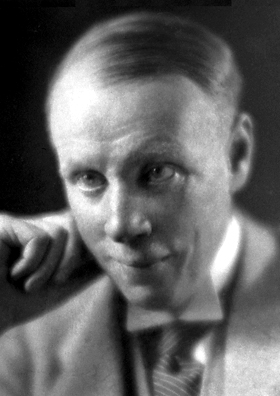
Sinclair Lewis
Harry Sinclair Lewis was an American novelist, short-story writer, and playwright. In 1930, he became the first author from the United States to receive the Nobel Prize in Literature, which was awarded "for his vigorous and graphic art of description and his ability to create, with wit and humor, new types of characters." Lewis wrote six popular novels: Main Street (1920), Babbitt (1922), Arrowsmith (1925), Elmer Gantry (1927), Dodsworth (1929), and It Can't Happen Here (1935).
Trending & Selected Quotes
Trending topics shown first"Sinclair Lewis was a crypto-sentimentalist and a slovenly writer who managed a slight falsification of life in order to move the reader."
"Hours then of blasphemy and fury and debate, all in the theological terms that seem shocking to the literate citizens today, who believe in God but just don't care to mention him or any of the other l…"
"Men who had made five thousand, year before last, and ten thousand last year, were urging on nerve-yelping bodies and parched brains so that they might make twenty thousand this year; and the men who …"
"I think perhaps we want a more conscious life. We're tired of drudging and sleeping and dying. We're tired of seeing just a few people able to be individualists. We're tired of always deferring hope t…"
"I must say I'm not very fond of oratory that's so full of energy it hasn't any room for facts. ~ Martin, Ch. 22"
"Under a tyranny, most friends are a liability. One quarter of them turn "reasonable" and become your enemies, one quarter are afraid to speak, and one quarter are killed and you die with them. But the…"
Works & Publications
No works or publications documented yet.
Timeline
1885
Born
Birth1951
Died
Death
Influenced By
Thinkers whose ideas shaped Sinclair's philosophy


Influenced
Thinkers whose work was shaped by Sinclair's ideas






Source Attribution
Information about Sinclair Lewis is sourced from curated knowledge bases and cross-referenced for accuracy. Influence relationships are scored by thematic overlap and historical plausibility.


