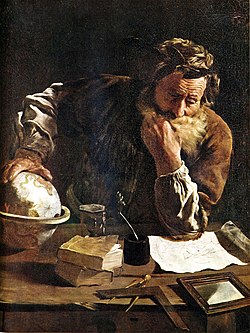
Archimedes
Archimedes of Syracuse was an Ancient Greek mathematician, physicist, engineer, astronomer, and inventor from the city of Syracuse in Sicily. Although few details of his life are known, based on his surviving work, he is considered one of the leading scientists in classical antiquity, and one of the greatest mathematicians of all time. Archimedes anticipated modern calculus and analysis by applying the concept of the infinitesimals and the method of exhaustion to derive and rigorously prove many geometrical theorems, including the area of a circle, the surface area and volume of a sphere, the area of an ellipse, the area under a parabola, the volume of a segment of a paraboloid of revolution, the volume of a segment of a hyperboloid of revolution, and the area of a spiral.
Career Journey
Background
- Born in
- Syracuse
Trending & Selected Quotes
Trending topics shown first"Any segment of a right-angled conoid cut off by a plane at right angles to the axis is 1½ times the cone which has the same base and the same axis as the segment"
"Archimedes - The Greek mathematician and his Eureka moments" on BBC 4 ."
"The Archimedes Palimpsest project at The Walters Art Museum in Baltimore, Maryland"
"Equal weights at equal distances are in equilibrium and equal weights at unequal distances are not in equilibrium but incline towards the weight which is at the greater distance."
"I thought fit to... explain in detail in the same book the peculiarity of a certain method, by which it will be possible... to investigate some of the problems in mathematics by means of mechanics. Th…"
Works & Publications
No works or publications documented yet.
Timeline
-286
Born
Birth-211
Died
Death
Influenced By
Thinkers whose ideas shaped Archimedes's philosophy
No known influences documented.
Influenced
Thinkers whose work was shaped by Archimedes's ideas
No influenced thinkers documented yet.
Source Attribution
Information about Archimedes is sourced from curated knowledge bases and cross-referenced for accuracy. Influence relationships are scored by thematic overlap and historical plausibility.


