Republic of Florence
Quotes & Thinkers from Republic of Florence
8 thinkers404 quotesTop field: Philosophy
"The end of the republic is to enervate and to weaken all other bodies so as to increase its own body."
Field:
Sort:
Notable Thinkers
8 of 8
Niccolò Machiavelli
Philosophy
High Renaissance
1449–1527
"A prince who is not wise himself will never take good advice."
59 quotes

Leonardo da Vinci
Mathematics
Renaissance
1452–1519
"Subito salse in me due cose: paura e desiderio: paura per la minacciante e scura spelonca, desiderio per vedere se là entro fusse alcuna miracolosa cosa. (Ancient Italian)"
294 quotes

Marsilio Ficino
Philosophy
Neoplatonism
1433–1499
"The intellect is prompted by nature to comprehend the whole breadth of being. ... Under the concept of truth it knows all, and under the concept of the good it desires all."
5 quotes

Petrarch
Literature
1304–1374
"Books have led some to learning and others to madness, when they swallow more than they can digest."
25 quotes

Girolamo Savonarola
Religion
Western philosophy
1452–1498
"Do you wish to be free? Then above all things, love God, love your neighbor, love one another, love the common weal; then you will have true liberty."
11 quotes

Giorgio Vasari
Art
Renaissance
1511–1574
5 quotes

Francesco Guicciardini
Politics
1483–1540
2 quotes
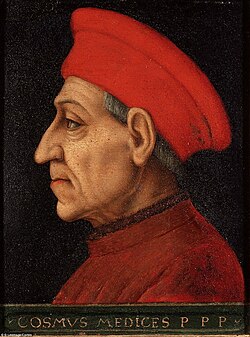
Cosimo de' Medici
Politics
1519–1574
"There is in gardens a plant which one ought to leave dry, although most people water it. It is the weed called envy."
3 quotes
Notable Quotes
"Nature creates few men brave, industry and training makes many. Discipline in war counts more than fury."
— Niccolò Machiavelli, b. 1449View →
"The Seven Books on the Art of War" at the Marxists Internet Archive"
— Niccolò Machiavelli, b. 1449View →
"A prince who is not wise himself will never take good advice."
— Niccolò Machiavelli, b. 1449View →
"...debbe un uomo prudente entrare sempre per vie battute da uomini grandi, e quelli che sono stati eccellentissimi, imitare..."
— Niccolò Machiavelli, b. 1449View →
"It is easier for the prince to make friends of those men who were contented under the former government, and are therefore his enemies, than of those who, being discontented with it, were favourable to him and encouraged him to seize it."
— Niccolò Machiavelli, b. 1449View →