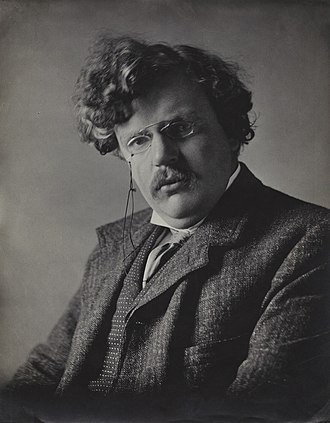
"In the days when Stevenson's ancestors the Covenanters were fighting with the Cavaliers, a fine old Cavalier of the Episcopalian persuasion made a rather interesting remark; that the change he really hated was represented by saying 'The Lord' instead of 'Our Lord.' The latter implied affection, the former only fear; indeed he described the former succinctly as the talk of devils. And this is so far true that the very eloquent language in which the name of 'The Lord' has figured has generally been the language of might and majesty and even terror. And there really was implied in it in varying degrees the idea of glorifying God for His greatness rather than His goodness. And again there occurred the natural inversion of ideas. Since the Puritan was content to cry with the Moslem: 'God is great,' so the descendant of the Puritan is always a little inclined to cry with the Nietzschean: 'Greatness is God.' In some of the really evil extremes, this sentiment shaded darkly into a sort of diabolism."
React to this quote
More by G. K. Chesterton
See allResonant Thoughts
"Without dynamic conquering spirit, even devotion to a divine cause will be of little avail In this hard world which is an arena for trial of strength with brute forces, mere goodness or noble virtues …"
Explore Further
Related Quotes
"The flag is the embodiment, not of sentiment, but of history. It represents the experiences made by men and…"
— Woodrow Wilson"I spill water on myself all the time at nice restaurants. I've run into poles and knocked myself out."
— Kristin Kreuk"At home in South Africa I have sometimes said in big meetings where you have black and white together: 'Rai…"
— Desmond Tutu"If you want work well done, select a busy man ‚ the other kind has no time."
— Elbert Hubbard"The EU invests £11bn a year on manufacturing innovation programmes of which 15% are invested here in the UK."
— Tom Watson (Labour politician)"The men who traveled to California in the Gold Rush years had a conscious sense of the need to organize. Th…"
— J. S. Holliday





