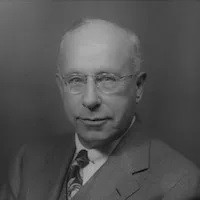
"It is in the nature of a leader’s work that he should be a realist and should recognize the need for action, even when the outcome cannot be foreseen, but also that he should be idealist and in the broadest sense pursue goals some of which can only be attained in a succeeding generation of leaders. Many leaders when they reach the apex of their powers have not long to go, and they press onward by paths the ends of which they will not themselves reach. In business, in education, in government, in religion, again and again, I see men who, I am sure, are dominated by this motive, though unexpressed, and by some queer twist of our present attitudes often disavowed. Yet, ‘Old men plant trees’... to shape the present for the future by the surplus of thought and purpose which we now can muster seems the very expression of the idealism which underlies such social coherence as we presently achieve, and without this idealism we see no worthy meaning in our lives, our institutions, or our culture."
React to this quote
More by Chester Barnard
See allResonant Thoughts
"There are some people whose dread of human beings is so morbid that they reach a point where they yearn to see with their own eyes monsters of ever more horrible shapes. And the more nervous they are-…"
"With respect to the theological view of the question. This is always painful to me. I am bewildered. I had no intention to write atheistically. But I own that I cannot see as plainly as others do, and…"
Explore Further
Related Quotes
"I'm seeing businesses embrace the Quiet Revolution as the next great diversity issue of our time."
— Susan Cain"I was a history major at Bowdoin and as I looked at different movements in different stages in history, it …"
— Kenneth Chenault"The possibility of democracy on a global scale is emerging today for the very first time."
— Michael Hardt and Antonio Negri"I came up with vaccines that people didn't think we'd have for five years"
— Donald Trump"Today’s events are tomorrow’s history, yet events seen by the naked eye lack the depth and breadth of human…"
— Epifanio de los Santos"Jesus will take me safe trough... I shall see Jesus, who created all things, Jesus, who made the worlds; I …"
— David Brewster


