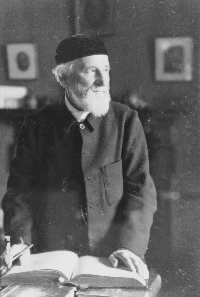
"Whatever is in motion must be put in motion by another. If that by which it is put in motion be itself put in motion, then this also must needs be put in motion by another, and that by another again. But this cannot go on to infinity, because then there would be no first mover, and, consequently, no other mover; seeing that subsequent movers move only inasmuch as they are put in motion by the first mover; as the staff moves only because it is put in motion by the hand. Therefore it is necessary to arrive at a first mover, put in motion by no other; and this everyone understands to be God."

React to this quote
More by Thomas Aquinas
See allResonant Thoughts
"Shortly after the ignominious expulsion of the Texas invaders, General J.H. Carleton was appointed to the command of this Department, and with the greatest promptitude he turned his attention to the f…"
"Large-scale riots in East Pakistan have compelled over two lakh Hindus and other minorities to come over to India. Indians naturally feel incensed by the happenings in East Bengal. To bring the situat…"
Explore Further
Related Quotes
"Analysis of a system reveals its structure and how it works. It provides the knowledge required to make it …"
— Russell L. Ackoff"We want to know not merely what men have been, even the best men of their day, but what men can and ought t…"
— R. W. K. Paterson"Only Communists and Social Democrats who acted against the state were incarcerated. Most of the Communists …"
— Fritz Sauckel"There is nothing like losing all you have in the world for teaching you what not to do. And when you know w…"
— Edwin Lefèvre"The best of those amongst you is the one who learns the Qur’an and then teaches it to others."
— Prophet Muhammad ﷺ"Our model citizen is a sophisticate who before puberty understands how to produce a baby, but who at the ag…"
— Wendell Berry