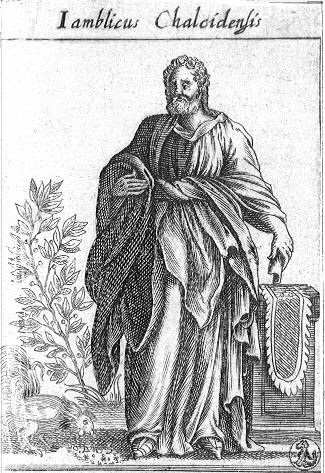
"Since wise people are in the habit of invoking the divinities at the beginning of any philosophic consideration, this is all the more necessary on studying that one which is justly named after the divine Pythagoras. Inasmuch as it emanated from the divinities it could not be apprehended without their inspiration and assistance. Besides, its beauty and majesty so surpasses human capacity, that it cannot be comprehended in one glance. Gradually only can some details of it be mastered when, under divine guidance we approach the subject with a quiet mind. Having therefore invoked the divine guidance, and adapted ourselves and our style to the divine circumstances, we shall acquiesce in all the suggestions that come to us. Therefore we shall not begin with any excuses for the long neglect of this sect, nor by any explanations about its having been concealed by foreign disciplines, or mystic symbols, nor insist that it has been obscured by false and spurious writings, nor make apologies for any special hindrances to its progress. For us it is sufficient that this is the will of the Gods, which all enable us to undertake tasks even more arduous than these. Having thus acknowledged our primary submission to the divinities, our secondary devotion shall be to the prince and father of this philosophy as a leader."
React to this quote
More by Iamblichus
See allResonant Thoughts
"Suffering, my son, is the fount of love. Suffering is the grace, the great grace, which our Father in heaven pours down upon us. For suffering gives men submissive hearts. He that does not suffer thin…"
Explore Further
Related Quotes
"God is nearer to us than our own Soul: for He is Ground in whom our Soul standeth, and He is Mean that keep…"
— Julian of Norwich"Working in the abstract way seems to release one’s personality and sharpen the perceptions so that in the o…"
— Barbara Hepworth"Make it thy business to know thyself, which is the most difficult lesson in the world."
— Miguel de Cervantes"When study becomes labor, we had better change the subject-matter as quickly as possible."
— Henry S. Haskins"Do you know the only thing that gives me pleasure? It's to see my dividends coming in."
— John D. Rockefeller"I had different views in the '70s. As a human being, I've learned… I have more culture now. I was dumb as a…"
— Merle Haggard





