Thinkers of the Classical Antiquity

Archimedes
286 BCE – 211 BCE
Sciencequotes
Archimedes of Syracuse was an Ancient Greek mathematician, physicist, engineer, astronomer, and inventor from the city of Syracuse in Sicily. Although few details of his life are known, based on his surviving work, he is considered one of the leading scientists in classical antiquity, and one of the greatest mathematicians of all time. Archimedes anticipated modern calculus and analysis by applying the concept of the infinitesimals and the method of exhaustion to derive and rigorously prove many geometrical theorems, including the area of a circle, the surface area and volume of a sphere, the area of an ellipse, the area under a parabola, the volume of a segment of a paraboloid of revolution, the volume of a segment of a hyperboloid of revolution, and the area of a spiral.
Archimedes and the Rhombicuboctahedron" by Antonio Gutierrez

Menander
340 BCE – 290 BCE
Literaturequotes
Menander was a Greek playwright and the best-known representative of Athenian New Comedy. He wrote 108 comedies and took the prize at the Lenaia festival eight times. His record at the City Dionysia is unknown.
The truth sometimes not sought for comes forth to the light.

Aristarchus of Samos
309 BCE – 229 BCE
Mathematicsquotes
Aristarchus of Samos was an ancient Greek astronomer and mathematician who presented the first known heliocentric model that placed the Sun at the center of the universe, with the Earth revolving around the Sun once a year and rotating about its axis once a day. He also supported the theory of Anaxagoras that the Sun was just another star.
John Louis Emil Dreyer, History of the planetary systems from Thales to Kepler
Epicurus
341 BCE – 269 BCE
Philosophyquotes
Epicurus was an ancient Greek philosopher who founded the philosophical school of Epicureanism, which teaches that management of one's desires, removal of unnecessary fears, friendship, and virtuous living lead to a pleasant life and constant happiness, the highest good.
He who is not satisfied with a little, is satisfied with nothing.
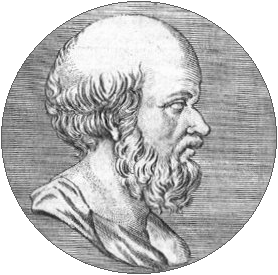
Eratosthenes
276 BCE – 194 BCE
Mathematicsquotes
Eratosthenes of Cyrene was an Ancient Greek polymath: a philosopher, scholar, mathematician, geographer, poet, astronomer, and music theorist. Eratosthenes eventually became the chief librarian at the Library of Alexandria. His work was the precursor to the modern discipline of geography, and he introduced some of its terminology, coining the terms geography and geographer.

Xun Zi
313 BCE – 238 BCE
Philosophyquotes
Xunzi, born Xun Kuang, was a late Warring States period Confucian Chinese philosopher, often ranked as the third great Confucian philosopher of antiquity after his predecessors Confucius and Mencius. By his time, Confucianism had suffered considerable criticism from Taoist and Mohist thinkers, and Xunzi is traditionally regarded as a synthesizer of these traditions with earlier Confucian thought. The result was a thorough and cohesive revision of Confucianism, which was crucial to the philosophy's ability to flourish in the Han dynasty and throughout the later history of East Asia.
The person attempting to travel two roads at once will get nowhere.

Ashoka
303 BCE – 231 BCE
Economicsquotes
Ashoka, also known as Asoka or Aśoka, most commonly known as Ashoka the Great, was Emperor of Magadha from c. 268 BCE until his death, and the third ruler of the Maurya Empire. His empire covered a large part of the Indian subcontinent, stretching from present-day Afghanistan in the west to present-day Bangladesh in the east, with its capital at Pataliputra. A patron of Buddhism, he is credited with an important role in the spread of Buddhism across ancient Asia.
In Our Time : Ashoka the Great, by Melvyn Bragg with Richard Gombrich et al, BBC Radio 4

Chrysippus
280 BCE – 207 BCE
Philosophyquotes
Chrysippus of Soli was a Greek Stoic philosopher. He was a native of Soli, Cilicia, but moved to Athens as a young man, where he became a pupil of the Stoic philosopher Cleanthes. When Cleanthes died, around 230 BC, Chrysippus became the third head of the Stoic school.
The universe itself is God and the universal outpouring of its soul
Words from January 6
"Archimedes and the Rhombicuboctahedron" by Antonio Gutierrez"
Archimedes
286 BCE
"Archimedes - The Greek mathematician and his Eureka moments" on BBC 4 ."
Archimedes
286 BCE
"The truth sometimes not sought for comes forth to the light."
Menander
340 BCE
"Marriage, if one will face the truth, is an evil, but a necessary evil."
Menander
340 BCE
"John Louis Emil Dreyer, History of the planetary systems from Thales to Kepler"
Aristarchus of Samos
309 BCE
"He who is not satisfied with a little, is satisfied with nothing."
Epicurus
341 BCE