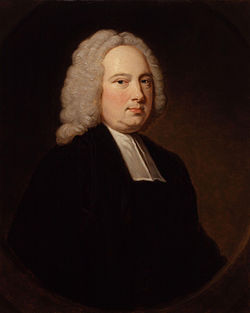
James Bradley
James Bradley was an English astronomer and priest who served as the third Astronomer Royal from 1742. He is best known for two fundamental discoveries in astronomy, the aberration of light (1725–1728), and the nutation of the Earth's axis (1728–1748).
Background
- Born in
- Connecticut
Trending & Selected Quotes
Trending topics shown first"I give all my printed books to Samuel Peach, son of Samuel Peach, in my Will named, and desire that this may be a codicil to my last Will and Testament, and taken as part thereof, as witness my hand, …"
"I would by no means attempt to infer from hence, that the longitude found by observations of this sort may in all cases be depended upon within one degree; but I beg leave to observe, that whatever ex…"
"My Instrument being fixed, I immediately began to observe such Stars as I judged most proper to give me light into the Cause of the Motion... There was Variety enough of small ones; and not less than …"
"When the year was completed, I began to examine and compare my observations, and having pretty well satisfied myself as to the general laws of the phenomena, I then endeavored to find out the cause of…"
"Reduction of the Observations made by Bradley at Kew and Wansted August Ludwig Busch."
Works & Publications
No works or publications documented yet.
Timeline
1692
Born
Birth1762
Died
Death
Influenced By
Thinkers whose ideas shaped James's philosophy
No known influences documented.
Influenced
Thinkers whose work was shaped by James's ideas
No influenced thinkers documented yet.
Source Attribution
Information about James Bradley is sourced from curated knowledge bases and cross-referenced for accuracy. Influence relationships are scored by thematic overlap and historical plausibility.
Related Thinkers
See all →



Explore Further
Related Quotes
"As many more individuals of each species are born than can possibly survive; and as, consequently, there is…"
— Charles Darwin"This fact is clear to those who know it."
— Saul Gorn"Hayek’s move from economic theory to political philosophy was a natural evolution in his ideas. First, he c…"
— Alan O. Ebenstein"The biology of extinction is not a pleasant subject. The death of a species is especially disheartening to …"
— E. O. Wilson"Sybil had an unreal, larger-than-life feeling . . . as if she were a person in a book."
— Rudy Rucker"Ingels: A number of current theoretical explorations will turn out to be passing fancies..."
— Abraham Pais


