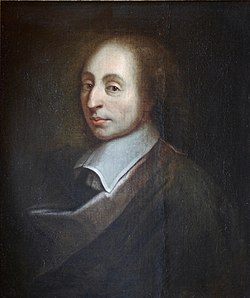
Blaise Pascal
Blaise Pascal was a French mathematician, physicist, inventor, philosopher, and Catholic writer.
Trending & Selected Quotes
Trending topics shown first"God only pours out his light into the mind after having subdued the rebellion of the will by an altogether heavenly gentleness which charms and wins it."
"Five rules are of absolute necessity, and cannot be dispensed with without essential defect and often without error."
"It is necessary to have regard to the person whom we wish to persuade, of whom we must know the mind and the heart, what principles he acknowledges, what things he loves; and then observe in the thing…"
"One, knowing the duties of man and being ignorant of his impotence, is lost in presumption, and that the other, knowing the impotence and being ignorant of the duty, falls into laxity; whence it seems…"
Works & Publications
No works or publications documented yet.
Timeline
1623
Born
Birth1662
Died
Death
Influenced By
Thinkers whose ideas shaped Blaise's philosophy
No known influences documented.
Influenced
Thinkers whose work was shaped by Blaise's ideas


Source Attribution
Information about Blaise Pascal is sourced from curated knowledge bases and cross-referenced for accuracy. Influence relationships are scored by thematic overlap and historical plausibility.
Related Thinkers
See all →


Explore Further
Related Quotes
"Descartes maintained his confidence in the instantaneity of light. … Yet in his derivation of the law of re…"
— Carl Benjamin Boyer"Laplace created a number of new mathematical methods that were subsequently expanded into branches of mathe…"
— Morris Kline"Such a weapon goes far beyond any military objective and enters the range of very great natural catastrophe…"
— Enrico Fermi"Of the many forms of false culture, a premature converse with abstractions is perhaps the most likely to pr…"
— George Boole"The softness, and the glare, and the temptations, and the licence, and the lax examples about us, are more …"
— Henry Edward Manning"The idealist doctrine then may be summed up by saying that each individual has two orderings, one which gov…"
— Kenneth Arrow


