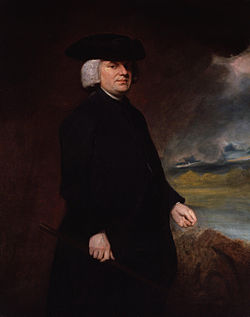
William Paley
William Paley was an English Anglican clergyman, philosopher, and utilitarian. He was at times referred to as a Christian apologist by his critics. He is best known for his natural theology exposition of the teleological argument for the existence of God in his 1802 work Natural Theology or Evidences of the Existence and Attributes of the Deity, which made use of the watchmaker analogy.
Background
- Born in
- Peterborough
- Educated at
- University of CambridgeChrist's CollegeGiggleswick School
Trending & Selected Quotes
Trending topics shown first"Wanton, and, what is worse, studied cruelty to brutes, is certainly wrong."
"In all cases, wherein the mind feels itself in danger of being confounded by variety, it is sure to rest upon a few strong points, or perhaps upon a single instance. Amongst a multitude of proofs, it …"
"Natural Theology: or, Evidences of the Existence and Attributes of the Deity 12th edition"
"The infidelity of the Gentile world, and that more especially of men of rank and learning in it, is resolved into a principle which, in my judgment, will account for the inefficacy of any argument, or…"
"It is at any rate evident, that a large and ample province remains for the exercise of Providence, without its being naturally perceptible by us; because obscurity, when applied to the interruption of…"
Works & Publications
No works or publications documented yet.
Timeline
1743
Born
Birth1805
Died
Death
Influenced By
Thinkers whose ideas shaped William's philosophy
No known influences documented.
Influenced
Thinkers whose work was shaped by William's ideas
No influenced thinkers documented yet.
Source Attribution
Information about William Paley is sourced from curated knowledge bases and cross-referenced for accuracy. Influence relationships are scored by thematic overlap and historical plausibility.
Related Thinkers
See all →

Explore Further
Related Quotes
"When the production process demands less work and distributes less and less wages, it gradually becomes obv…"
— André Gorz"The materialist theory of knowledge amounts, then, to this statement, that the human organ of cognition rad…"
— Joseph Dietzgen"Truths are not relative. What is relative are opinions about truth."
— Nicolás Gómez Dávila"Lectures on the Principles of Political Obligation"
— T. H. Green"Petrarch - the poet who lost his head" in The Guardian"
— Petrarch"It behoveth the sovereigns of the world may God assist them or the ministers of the earth to take counsel t…"
— Bahá'u'lláh




