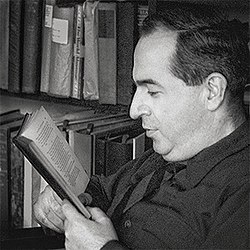
Eli Siegel
Eli Siegel was a poet, critic, and educator. He founded Aesthetic Realism, a philosophical movement based in New York City. An idea central to Aesthetic Realism—that every person, place or thing in reality has something in common with all other things—was expressed in the title poem of his first volume, Hot Afternoons Have Been in Montana: Poems.
Background
- Born in
- New York City
- Educated at
- Baltimore City College
Trending & Selected Quotes
Trending topics shown first"So we are alone in our blood and bones and our thoughts. It seems we are separate if we want to feel that way. And yet we can look out."
"All art puts separateness and togetherness together. All selves want to do this."
"Aesthetics is related to every particular conflict; to everyday conflict."
"Art is internal and external. The repose a person feels in aesthetic creation comes from his, for the time, feeling he is what he is and also what he is not. Ego and otherness don't fight for the whil…"
Works & Publications
No works or publications documented yet.
Timeline
1902
Born
Birth1978
Died
Death
Influenced By
Thinkers whose ideas shaped Eli's philosophy
No known influences documented.
Influenced
Thinkers whose work was shaped by Eli's ideas
No influenced thinkers documented yet.
Source Attribution
Information about Eli Siegel is sourced from curated knowledge bases and cross-referenced for accuracy. Influence relationships are scored by thematic overlap and historical plausibility.
Related Thinkers
See all →

Explore Further
Related Quotes
"June 7, 1776, Richard Henry Lee, on behalf of the Virginia delegation, submitted to the Continental Congres…"
— Carl L. Becker"Whatever may be the discoveries of the scientific mind, none can dispute the eternal truths propounded by t…"
— Paul Deussen"At different degrees, everything is pathology, except for indifference."
— Emil Cioran"Apart from logical cogency, there is to me something a little odd about the ethical valuations of those who…"
— Bertrand Russell"Knowledge of the fact differs from knowledge of the reason for the fact."
— Aristotle"It will be easy for us once we receive the ball of yarn from Ariadne and then go through all the mazes of t…"
— Søren Kierkegaard




