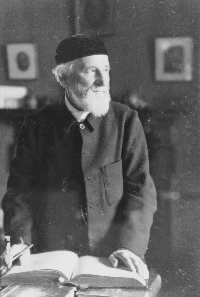
"Sirhindi’s harsh stance with regard to the martial jihad and the subjugation of those who refuse to embrace Islam is no less uncompromising than that of his Sufi spiritual predecessors al-Jilani, al-Ghazali, and Ibn ‘Arabi. Like the other Sufi s whose writings we have examined thus far, Sirhindi exemplifi es the Sufi synthesis of the spiritual path with outward doctrinal concerns in that in his writings he addresses esoteric spiritual topics as well as practical matters concerning the Muslim conduct of state with regard to non-Muslims."

More by Imam Ahmad Sirhindi (R.A.)
See allResonant Thoughts
"As long as the working-people fold hands and pray the gods in Washington to give them work, so long they will not get it. So long as they tramp the streets, whose stones they lay, whose filth they cle…"
"The growers in Delano have their spiritual problems... we do not deny that. They have every right to have priests and ministers who serve their needs. But we have different needs, and so we needed a f…"
Explore Further
Related Quotes
"The day after your departure I started a new painting at Le Cours-la-Reine, in the afternoon in a glow of s…"
— Camille Pissarro"Well, I looked at Picasso until I could smell his armpits and the cigarette smoke on his breast. Finally, i…"
— William Baziotes"But I respectfully suggest, Major, that the responsibility is slightly above your pay grade, to decide whet…"
— Joe Biden"Has mankind evolved to a point that there exists, or that with creative additions and re-combinations of mo…"
— Arthur D. Hall"Republican Party, you're a lie factory, that's all you do."
— Alan Grayson"She has a fascination with Mayan prophecies, and she's writing a book that's sort of her remembrance of her…"
— Brandon Boyd