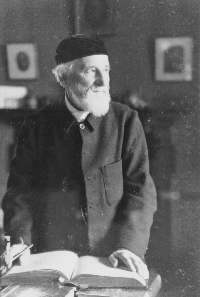
"The reason of a commandment, whether positive or negative, is clear, and its usefulness evident, if it directly tends to remove injustice, or to teach good conduct that furthers the well-being of society, or to impart a truth which ought to be believed either on its own merit or as being indispensable for facilitating the removal of injustice or the teaching of good morals. There is no occasion to ask for the object of such commandments; for no one can, e.g., be in doubt as to the reason why we have been commanded to believe that God is one; why we are forbidden to murder, steal, and to take vengeance, or to retaliate, or why we are commanded to love one another. But there are precepts concerning which people are in doubt, and of divided opinions, some believing they are mere commands, and serve no purpose whatever, whilst others believe that they serve a certain purpose, which, however is unknown to man. Such are those precepts which in their literal meaning do not seem to further any of the three above-named results: to impart some truth, to teach some moral, or to remove injustice. They do not seem to have any influence upon the well-being of the soul by imparting any truth, or upon the well-being of the body by suggesting such ways and rules as are useful in the government of a state, or in the management of a household. ...I will show that all these and similar laws must have some bearing upon one of the following three things, viz., the regulation of our opinions, or the improvement of our social relations, which implies two things, the removal of injustice, and the teaching of good morals."

React to this quote
More by Maimonides
See allResonant Thoughts
"People with wisdom know that it is important to correct their own mistakes, while people without wisdom find it necessary to point out the mistakes of others. People with strong faith know that it is …"
"It isn’t surprising that Trump would be reading Jihad Watch. ... What makes this striking is that Trump made no secret of reading this site, unlike numerous others who are so afraid of the politically…"
Explore Further
Related Quotes
"He started as a batsman and the bowling took over, now he's picking up the batting again, which is good bec…"
— Greg Chappell"We received Jewish refugees during the Holocaust, Vietnamese refugees after the Vietnam War. We are even pr…"
— Francis Escudero"Took a stranger to teach me to look into justice's beautiful face, and to see an eye for an eye and a tooth…"
— Bob Dylan"In fact, gory horror movies don't rank on the movies that I like. Good horror movies are great, but I just …"
— Rob Zombie"In regard to foreign policy, I would deal with nations as equitable law requires individuals to deal with e…"
— Ulysses S. Grant"Zionism from its outset was a settlement movement. If we stop going on this path, how can we justify the fa…"
— Reuven Rivlin