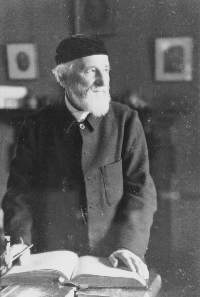
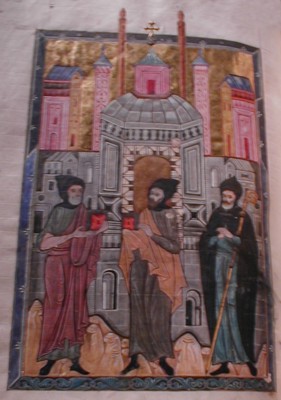
"The first corporeal form, which some call corporeity, I hold to be light. For light of its own nature diffuses itself in all directions, so that from a point of light a sphere of light of any size may be instantly generated, provided an opaque body does not get in the way. Corporeity is what necessarily follows the extension of matter in three dimensions, since each of these, that is corporeity and matter, is a substance simple in itself and lacking all dimensions. But simple form in itself and in dimension lacking matter and dimension, it was impossible for it to become extended in every direction except by multiplying itself and suddenly diffusing itself in every direction and in its diffusion extending matter; since it is not possible for form to do without matter because it is not separable, nor can matter itself be purged of form. And, in fact, it is light, I suggest, of which this operation is part of the nature, namely, to multiply itself and instantaneously diffuse itself in every direction. Therefore, whatever it is that produces this operation is either light itself or something that produces this operation in so far as it participates in light, which produces it by its own nature. Corporeity is therefore either this light, or is what produces the operation in question and produces dimensions in matter in so far as it participates in this light itself and acts by virtue of this same light. But for the first form to produce dimensions in matter by virtue of a subsequent form is impossible. Therefore light is not the form succeeding this corporeity, but is this corporeity itself."

React to this quote
More by Robert Grosseteste
See allResonant Thoughts
"Amid the destructive convulsions of the physical world, even pious minds may have for an instant questioned the superintending providence of God. In the midst of famine, or pestilence, or war, they ma…"
"Only a male intellect clouded by the sexual drive could call the stunted, narrow-shouldered, broad-hipped and short-legged sex the fair sex: for it is with this drive that all its beauty is bound up. …"
Explore Further
Related Quotes
"These symposia may have been, as much as anything, occasions to release the pent-up anxieties of a society …"
— Thomas Cahill"One way to increase the chances that the suffering of wild animals will be taken into account in research a…"
— Ole Martin Moen"Too many whites are getting away with drug use...Too many whites are getting away with drug sales...The ans…"
— Rush Limbaugh"Revolutions are not made; they come. A revolution is as natural a growth as an oak. It comes out of the pas…"
— Wendell Phillips"The worst thing that can happen during the 1980s is not energy depletion, economic collapse, limited nuclea…"
— E. O. Wilson"Hey, babe! Take a walk on the wild side."
— Lou Reed