#beauty

"That's five stars to start with. That's five stars to start with. That's Gil Evans, isn't it? The only thing that disturbed me about this—the whole thing, in its entirety, was tremendously satisfying: performance, orchestration is good, the harmonic usage is beautiful, the contrasting texture of orchestra, the whole thing is just great—but there are certain sections there when the background was so lovely it just seemed like the alto saxophone was out of place. Now this is the type of thing that just makes me smile. I enjoy every minute of it. I don't have to go for a "peak" and then think about something else while I'm listening. Gil Evans' writing, to me, is such a boon that when he came along with the Miles Ahead album, I was thankful, because since about the Stan Kenton Orchestra of 1952, where the writing had been very good, between Mulligan and Rugolo and the whole works, between those periods there had been a void, a retrogression back to the roots, and this took writing back to a standpoint which just wasn't interesting. So when Evans came along, I just flipped."
React to this quote

More by Clare Fischer

See all

“I have no idea who that is. It's a terrible performance, the band is horribly out of tune—is that Maynard Ferguson? It starts off at a dynamic peak and never deviates from it. It also starts out with what is supposed to be jazz musicians trying to play some sort of a Latin bag, which is not making it, because there's no solidity of rhythms. Latin rhythm sections being based on the constant contrast of instruments, and it never moves any place. And then that thing on the end—what's that supposed to be? An adaptation of Porgy and Bess of some sort? I guess it was some sort of an allusion toward Porgy and Bess. But then if it is, it's completely escaped all the rest of it. It's like giving a paragraph of reference out of a two-page article and then saying, Well, this is about this." That's one star for me.”

“That's wild! I'll start off with five stars and work backwards from there. Now there, to me, is the most perfect band in existence, whether you're thinking of it orchestrationally or in terms of Duke's immensely creative writing. I can't think of anybody I admire more than this man; nobody could even be compared with him, except Billy Strayhorn. Duke does something with this old, tired instrumentation of trumpets, trombones and saxophones, and he has a perfect way of utilizing the men's specific sounds. Anything he plays is a work of art. The band is out of tune, for instance, and it doesn't even matter. They almost have their own brand of intonation. Duke can take an exotic-sounding idea and create something – you might call it sophisticated crudity. It gives both the qualities that I look for – an earthy quality and the sophisticated quality.”

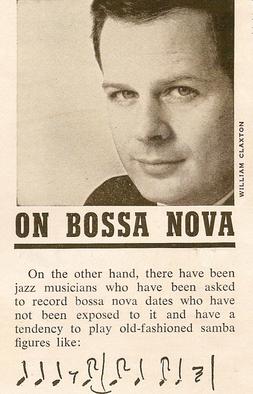
“I firmly believe that the more one is exposed to bossa nova, the less one is interested in how he can fit it to his jazz concept and the more he becomes interested in what his improvisation can do for bossa nova.”

“I had a chance to play that instrument for six days. Hearing German spoken around me made me think of my father, who died in 1960, and whom I hadn't thought much about in recent years. And I remembered what he meant to me. I played "Du, du liegst mir im Herzen" because my father used to sing it to me. So I sat there, thinking of my father, and weeping.”

“I've talked to him on the phone, received notes through the mail, but I've never seen him face to face. I sent him my last LP and I understand that he turned his head away as he took the disc out, saying, "I don't want to see what he looks like. I have this image and I don't want to destroy it." So there's a certain amount of mystery involved. I suppose if he knew I were a gray-haired, older guy with a big paunch, he might say, "Oh, that ruins it.”

“I'm gonna take a wild guess—I think that was Buddy DeFranco, and possibly the Glenn Miller Orchestra. The band strikes me as an enigma, in that, first of all, some interesting harmonic things are happening as far as the individual voicings are concerned, but yet it's played in an older, tighter fashion. For instance, the bass player, if there are chord changes happening every two beats, plays the root for two beats, then the next root for two beats—that type of sound. The harmony, especially in the opening part where the theme is established, is a lot more modern than that kind of band would normally sound. I think that they're playing that way to keep that Miller identity, with that rhythmic tightness”