"In the name of the dogma of struggle for existence and natural selection, they paint for us in the saddest colors this primitive humanity whose hunger and thirst, always badly satisfied, were their only passions; those sombre times when men had no other care and no other occupation than to quarrel with one another over their miserable nourishment. To react against those retrospective reveries of the philosophy of the eighteenth century and also against certain religious doctrines, to show with some force that the paradise lost is not behind us and that there is in our past nothing to regret, they believe we ought to make it dreary and belittle it systematically. Nothing is less scientific than this prejudice in the opposite direction. If the hypotheses of Darwin have a moral use, it is with more reserve and measure than in other sciences. They overlook the essential element of moral life, that is, the moderating influence that society exercises over its members, which tempers and neutralizes the brutal action of the struggle for existence and selection. Wherever there are societies, there is altruism, because there is solidarity."
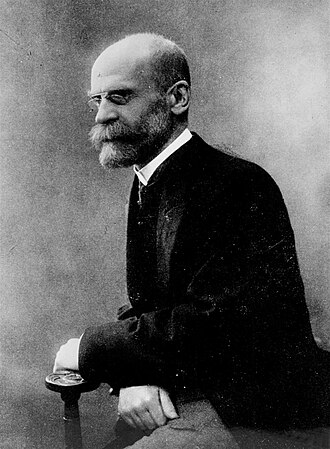
React to this quote
More by Émile_Durkheim
See allResonant Thoughts
"Thus our generation is one which comes home again from years of distant wandering. We discover affinities with earlier generations of English, generations before the “expansion of England”, who felt n…"
Explore Further
Related Quotes
"In silence and movement you can show the reflection of people."
— Marcel Marceau"People found ever more ingenious ways to hate each other."
— James K. Morrow"Bourgeois political economy … never gets to see man who is its real subject. It disregards the essence of m…"
— Herbert Marcuse"I walk down the road and people want to kiss me. I'd never do all that to anyone. Not Bachchan or Rajinikan…"
— Kamal Haasan"The higher the intellectual potential of people, the broader their tendency to self-organization, the more …"
— Tigran Sargsyan"There is some good evidence man contributes to global warming. But I say, so what? We can deal with that. I…"
— John Stossel
Related Thinkers





Related Topics
Deep Dives
- Albert Einstein on Human Nature
- Stephen Jay Gould on Human Nature
- Carl Sagan on Human Nature
- Michael Parenti on Human Nature
- Albert Einstein on life
- Albert Einstein on science
- Albert Einstein on knowledge
- Albert Einstein on mind
- Albert Einstein on religion
- Albert Einstein on philosophy
- knowledge & Beauty
- knowledge & Change