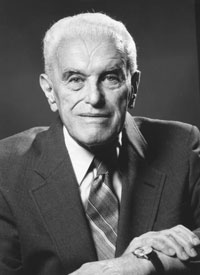
"In November 1944 the Nazi authorities finally decided to deport my labor unit from Budapest to an Austrian concentration camp, where most of my comrades eventually perished. But I was lucky enough to make my escape from the railway station in Budapest, just before our train left for Austria. Then a Jesuit father I had known gave me refuge in the cellar of their monastery."
React to this quote
More by John Harsanyi
See allResonant Thoughts
"She is a friend of my mind. She gather me, man. The pieces I am, she gather them and give them back to me in all the right order."
Explore Further
Related Quotes
"Doing the opposite might make you feel uncomfortable. It can be scary and make you feel lonely and exposed.…"
— Nigel Cumberland"The really great eccentrics are all inimitable; they are not possessed by a single oddity; they are, in the…"
— Robertson Davies"Shaw presumes that his friend Stalin has everything under control. Well, Stalin may have made special arran…"
— J. B. Priestley"The first guy you sent in here probably soiled his pants when he couldn't answer the simplest question and …"
— Neil Bauman"We had adopted a kind of solar uniformitarianism," solar physicist John Eddy suggested in retrospect. "As p…"
— John A. Eddy"So far as it depends on the course of this government, our relations of good will and friendship will be se…"
— John Tyler
Related Thinkers


Related Topics
Deep Dives
- David Cay Johnston on friendship
- Bernard Lietaer on friendship
- David Cay Johnston on politics
- David Cay Johnston on time
- David Cay Johnston on justice
- David Cay Johnston on life
- David Cay Johnston on knowledge
- David Cay Johnston on art
- David Cay Johnston on philosophy
- David Cay Johnston on money
- knowledge & Beauty
- knowledge & Change