"Let me explain a little: Certain things are bad so far as they go, such as pain, and no one, not even a lunatic, calls a tooth-ache good in itself; but a knife which cuts clumsily and with difficulty is called a bad knife, which it certainly is not. It is only not so good as other knives to which men have grown accustomed. A knife is never bad except on such rare occasions as that in which it is neatly and scientifically planted in the middle of one's back. The coarsest and bluntest knife which ever broke a pencil into pieces instead of sharpening it is a good thing in so far as it is a knife. It would have appeared a miracle in the Stone Age. What we call a bad knife is a good knife not good enough for us; what we call a bad hat is a good hat not good enough for us; what we call bad cookery is good cookery not good enough for us; what we call a bad civilization is a good civilization not good enough for us. We choose to call the great mass of the history of mankind bad, not because it is bad, but because we are better. This is palpably an unfair principle. Ivory may not be so white as snow, but the whole Arctic continent does not make ivory black."
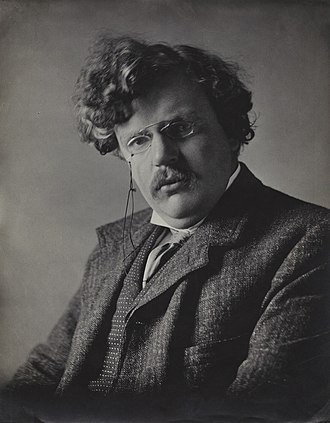
More by G. K. Chesterton
See allResonant Thoughts
"We are facing a very new and a very troubling assault on our fiscal security, on our very economic life and we are facing it from a thing called the video cassette recorder and its necessary companion…"
"Upon the earth are animals and men, some in a middle region, others dwelling about the air as we dwell about the sea; others in islands which the air flows round, near the continent; and in a word, th…"
Explore Further
Related Quotes
"Reinhard Selten at the MacTutor History of Mathematics archive"
— Reinhard Selten"History leaved no doubt that collective coercion and control is both the intent and effect of state surveil…"
— Glenn Greenwald"War has been with us ever since the dawn of civilization. Nothing has been more constant in history than war."
— Robert Aumann"The mixture of highly differentiated populations is a recurrent process in our history."
— David Reich (geneticist)"Accepting the view that man was prior in the creation, some Scriptural writers say that as the woman was of…"
— Elizabeth Cady Stanton"History is nothing whatever but a record of what living persons have done in the past."
— Rose Wilder Lane





