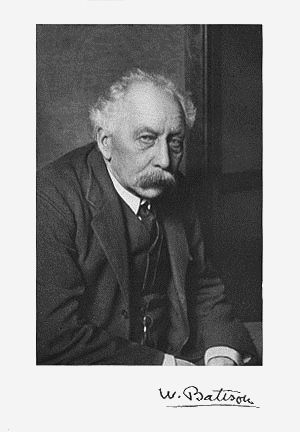
"Since the belief in transmission of acquired adaptations arose from preconception rather than from evidence, it is worth observing that, rightly considered, the probability should surely be the other way. For the adaptations relate to every variety of exigency. To supply themselves with food, to find it, to seize and digest it, to protect themselves from predatory enemies whether by offence or defence, to counter-balance the changes of temperature, or pressure, to provide for mechanical strains, to obtain immunity from poison and from invading organisms, to bring the sexual elements into contact, to ensure the distribution of the type; all these and many more are accomplished by organisms in a thousand most diverse and alternative methods. Those are the things that are hard to imagine as produced by any concatenation of natural events; but the suggestions that organisms had had from the beginning innate in them a power of modifying themselves, their organs and their instincts so as to meet these multifarious requirements does not materially differ from the more overt appeals to supernatural intervention. The conception, originally introduced by Hering and independently by S. Butler, that adaptation is a consequence or product of accumulated memory was of late revived by Semon and has been received with some approval, especially by F. Darwin. I see nothing fantastic in the notion that memory may be unconsciously preserved with the same continuity that the protoplasmic basis of life possesses. That idea, though purely speculative and, as yet, incapable of proof or disproof contains nothing which our experience of matter or of life at all refutes. On the contrary, we probably do well to retain the suggestion as a clue that may some day be of service. But if adaptation is to be the product of these accumulated experiences, they must in some way be translated into terms of physiological and structural change, a process frankly inconceivable."
React to this quote
More by William Bateson
See allResonant Thoughts
"Large-scale riots in East Pakistan have compelled over two lakh Hindus and other minorities to come over to India. Indians naturally feel incensed by the happenings in East Bengal. To bring the situat…"
Explore Further
Related Quotes
"Most people want everyone else in the world to change but themselves."
— Robert Kiyosaki"The progressive stack is basically a measure of how much you aren’t like, say, James Watt, the developer of…"
— Steve Sailer"which can support an open-ended number of theories organized in a lattice together with systematic metaleve…"
— John F. Sowa"Broca was quoted as saying, “I would rather be a transformed ape than a degenerate son of Adam."
— Carl Sagan"Renew, release, let go. Yesterday’s gone. There’s nothing you can do to bring it back. You can’t “should’ve…"
— Steve Maraboli"The test of our progress is not whether we add more to the abundance of those who have much; it is whether …"
— Franklin D. Roosevelt





