#money

"When you are poor you don’t have any social respect or social worth because everything is defined in terms of money and how much of it you have. This is what capitalism does. It turns all values into commercial values, even the value of life itself."
React to this quote

More by Kevin Rashid Johnson

See all

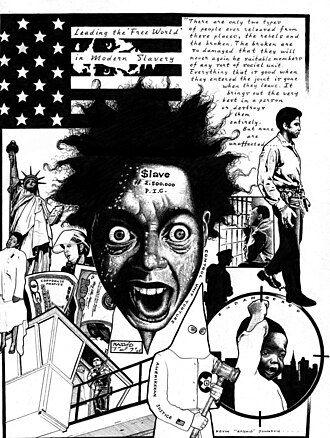
“Once U.S. prisons are recognized to be a system of enslavement, and the lie is exposed that slavery in Amerika was ever abolished, the abusive conditions that pervades them makes perfect sense.”

“With the added psychological deterrent of litigation, my clashes with the pigs declined somewhat in frequency. They focused primarily on isolating me from others. Their efforts to perpetuate a discontinuity in our unity has been the pigs’ only effective weapon against me. And they’ve admitted in a thousand ways that their greatest fear is ending up with many other prisoners on their hands who think and act as I do. Their isolating me was long a tactic that I could not devise an effective countermeasure against, that is, until after 2001, when I was first exposed to revolutionary theory and have since come to understand the role of ideology. Without a unifying ideology, there can be no unity of struggle. Ideology was something I’d never had, and thus something I could not share. The prisoners who’d united in struggle with me had done so because of me. Not because of a shared principle. Therefore, when I was no longer around, they lost the initiative to struggle on.”

“Under the old North Amerikan slave system it was openly admitted that people simply will not willingly submit to bondage and unremunerated forced labor. The human spirit naturally rebels against such a condition. Therefore the wealthy interests whose economic domination, power, prestige and wealth itself relied on slave labor, had to devise a system which would compel the submission of those to be kept in bondage.”

“Every prisoner confined in Texas is forced to work without pay. ... Only those very few with documented serious medical or mental health conditions which impair work performance, and those held in the TDCJ’s torturous segregation units, are not made to work. Often those with documented medical and mental health exemptions are still forced to work – their exemptions being simply ignored. Those who refuse to work are punished, thrown in segregated confinement, and their imprisonment is typically extended.”

“I appeared frequently in the courts – state and federal – for hearings and trials. Initially, I received routine compliments from judges – and grudgingly from defense attorneys – on my legal comprehension and ability. This all changed when I persisted in efforts to have the courts comply with the laws. I refused to accept the unwritten rule that certain issues are not to be challenged or exposed. My efforts were calculated to bring the courts to bear on DOC officials at the highest levels, to force them to change the conditions under which we lived, and conform them to basic requirements of the written laws. The courts had other plans. The state courts were not willing to grant these sorts of relief, although the letter of the law required it. They attempted instead, numerous times, to grant my release from prison.”

“Most people don’t quite relate US prisons to government sponsored torture. We can thank the mainstream corporate media and politicians for this. Since the 1960s and 1970s they’ve persistently projected the false image of US prisons as resorts where criminal predators eat chips, lift weights, and watch videos all day, much like the images given of slavery as an experience that Black folks actually enjoyed. These false images are sustainable because the real world of prisons is a hidden one, concealed behind walls and razor wire, inaccessible to the public.”