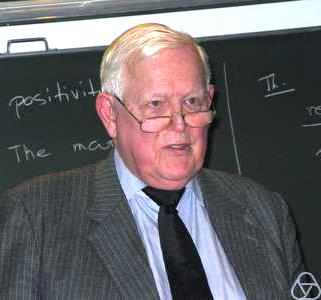
Rudolf E. Kálmán
Rudolf Emil Kálmán was a Hungarian-American electrical engineer, mathematician, and inventor. He is most noted for his co-invention and development of the Kalman filter, a mathematical algorithm that is widely used in signal processing, control systems, and guidance, navigation and control. For this work, U.S.
Background
- Born in
- Budapest
- Educated at
- Columbia UniversityMassachusetts Institute of Technology
- Awards
- 🏆 IEEE Medal of Honor🏆 National Medal of Science🏆 Leroy P. Steele Prize🏆 Charles Stark Draper Prize🏆 Guggenheim Fellowship
- Doctoral Advisors
- 🎓 John R. Ragazzini
- Doctoral Students
- 📖 Pierre Faurre📖 Eduardo D. Sontag
Trending & Selected Quotes
Trending topics shown first":: Conditions which guarantee a priori the existence, physical realizability, and stability of the optimal filter."
"I would like to comment briefly on Professor Zadeh's presentation. His proposals could be severely, ferociously, even brutally criticized from a technical point of view. This would be out of place her…"
"The computational aspect. The classical view is that a mathematical problem is solved if the solution is expressed by a formula. It is not a trivial matter, however, to substitute numbers in a formula…"
":: Characterization of the general results in terms of some simple quantities, such as signal-to-noise ratio, information rate, bandwidth, etc"
Works & Publications
No works or publications documented yet.
Timeline
1930
Born
Birth2016
Died
Death
Influenced By
Thinkers whose ideas shaped Rudolf's philosophy
No known influences documented.
Influenced
Thinkers whose work was shaped by Rudolf's ideas
No influenced thinkers documented yet.
Source Attribution
Information about Rudolf E. Kálmán is sourced from curated knowledge bases and cross-referenced for accuracy. Influence relationships are scored by thematic overlap and historical plausibility.
Related Thinkers
See all →


Explore Further
Related Quotes
"By searching out opportunities which match its strengths the firm can optimize the synergistic effects."
— Igor Ansoff"We are mainly interested in the processes... not... in presenting mathematics in its most abstract form. ..…"
— Richard Hamming"The ordinary logic has a great deal to say about genera and species, or in our nineteeth century dialect, a…"
— Charles Sanders Peirce"Most mathematicians are by nature Platonists who cheerfully, unreflectingly and habitually employ such load…"
— George Frederick James Temple"Now, let there be an indefinite succession of these inferential acts of comparative perception; and it is p…"
— Charles Sanders Peirce"or every type of experiment there is a numerical quantity, depending partly on the chance of the single eve…"
— Karl Pearson


