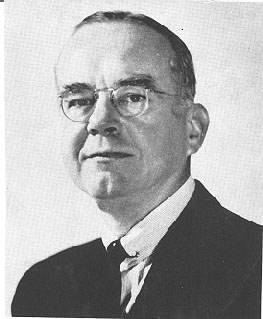
James Burnham
James Burnham was an American philosopher and political theorist. He chaired the New York University Department of Philosophy. Burnham was an editor and a regular contributor to William F.
Career Journey
Background
- Born in
- Chicago
- Educated at
- Princeton UniversityBalliol College
- Awards
- 🏆 Presidential Medal of Freedom
Trending & Selected Quotes
Trending topics shown first"The managers will exercise their control over the instruments of production and gain preference in the distribution of the products, not directly, through property rights vested in them as individuals…"
"The Russian revolution was not a socialist revolution... but a managerial revolution... Today Russia is the nation which has, in its structural aspects, advanced furthest along the managerial road."
"The faction fight in the Socialist Workers Party, its conclusion, and the recent formation of the Workers Party have been in my own case, the unavoidable occasion for the review of my own theoretical …"
"The contention that control over the instruments of production is everywhere undergoing a shift, away from the capitalists proper and toward the managers, will seem to many fantastic and naive, especi…"
"I shall present a theory - which I call "the theory of the managerial revolution." During the past century, dozens, perhaps even hundreds, of "theories of history" have been elaborated. All of the the…"
"... we must keep in mind an obvious principle of scientific method. To disprove the theory, it is not enough to show that it is not 100% certain,that difficulties confront it, and certain evidence seems…"
Works & Publications
No works or publications documented yet.
Timeline
1905
Born
Birth1987
Died
Death
Influenced By
Thinkers whose ideas shaped James's philosophy
No known influences documented.
Influenced
Thinkers whose work was shaped by James's ideas
No influenced thinkers documented yet.
Source Attribution
Information about James Burnham is sourced from curated knowledge bases and cross-referenced for accuracy. Influence relationships are scored by thematic overlap and historical plausibility.



