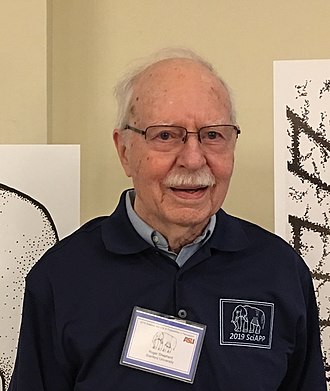
"Students of the human mind have long noted its ability to mimic internally the positive notions and transformations of objects in the external world. In the middle of the eighteenth century, the British empiricist David Hume wrote that to "join incongruous shapes and appearances costs the imagination no more trouble than to conceive the most natural and familiar objects" and that "this creative power of the mind amounts to no more than the faculty of compounding, transposing, augmenting, or diminishing the materials afforded us by the senses and experience."
React to this quote
More by Roger Shepard
See allResonant Thoughts
"any people would accept that we do not really have knowledge of the world; we have knowledge only of our representations of the world. Yet we seem condemned by our consitution to treat these represent…"
"The puella mother who has never taken up residence in her own body, and therefore fears her own chthonic nature, is not going to experience pregnancy as a quiet meditation with her unborn child, nor b…"
Explore Further
Related Quotes
"Original Letters and Primary Sources from Theodor Herzl Shapell Manuscript Foundation"
— Theodor Herzl"No sudden inspiration can replace the long years of arduous labor necessary to train the eye to observe, th…"
— Auguste Rodin"Here, I'm going to make you a big star … and you don't have to pay any dues. … For that, you're going to ge…"
— Phil Spector"In the long run, competitiveness derives from an ability to build, at lower cost and more speedily than com…"
— Gary Hamel"We are no longer ambitious for ourselves, but are rather inspired by the vision of a healed world. Inspirat…"
— Marianne Williamson"The present painter is concerned not with his own feelings or with the mystery of his own personality but w…"
— Barnett Newman
Related Thinkers




Related Topics
Deep Dives
- Albert Einstein on creativity
- Stephen Jay Gould on creativity
- Carl Sagan on creativity
- Charles Darwin on creativity
- Albert Einstein on life
- Albert Einstein on science
- Albert Einstein on knowledge
- Albert Einstein on mind
- Albert Einstein on religion
- Albert Einstein on philosophy
- knowledge & Beauty
- knowledge & Change