#religion
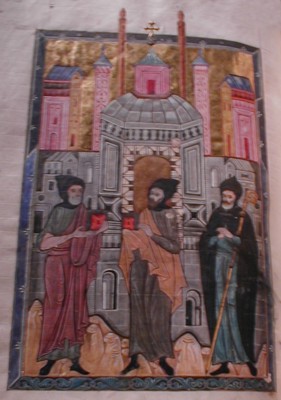
"The aversion of the first Christians to the images, inspired by the Pagan simulachres, made room, during the centuries which followed the period of the persecutions, to a feeling of an entirely different kind, and the images gradually gained their favour. Reappearing at the end of the fourth and during the course of the fifth centuries, simply as emblems, they soon became images, in the true acceptation of this word; and the respect which was entertained by the Christians for the persons and ideas represented by those images, was afterwards converted into a real worship. Representations of the sufferings which the Christians had endured for the sake of their religion, were at first exhibited to the people in order to stimulate by such a sight the faith of the masses, always lukewarm and indifferent. With regard to the images of divine persons of entirely immaterial beings, it must be remarked, that they did not originate from the most spiritualised and pure doctrines of the Christian society, but were rejected by the severe orthodoxy of the primitive church. These simulachres appear to have been spread at first by the Gnostics,—i.e., by those Christian sects which adopted the most of the beliefs of Persia and India. Thus it was a Christianity which was not purified by its contact with the school of Plato,—a Christianity which entirely rejected the Mosaic tradition, in order to attach itself to the most strange and attractive myths of Persia and India,—that gave birth to the images."

More by John Calvin
See allResonant Thoughts
"writers by whom, more than by any others, a new mode of political thinking was brought home to me, were those of the St. Simonian school in France. In 1829 and 1830 I became acquainted with some of th…"
— John Stuart Mill
Philosophy1806–1873
Explore Further
Related Quotes
"Genuine religion is not about speculating about God or the soul or about what happened in the past or will …"
— Leo Tolstoy"Free will is critical in a loving relationship because there cannot be love without the opportunity to oppo…"
— Bhakti Tirtha Swami"The Nine Satanic Sins"
— Anton LaVey"Only by presupposing God's prior and inconceivable forgiveness can the limitations of human good will be tr…"
— Hans Urs von Balthasar"Liberals chose Man. Conservatives chose God."
— Ann Coulter"Extensive bibliography at EarlyChurch.org"
— Eusebius of Caesarea