#music

"This revolution of music is paralleled by the increasing proliferation of machinery sharing in human labor. In the pounding atmosphere of great cities as well as in the formerly silent countryside, machines create today such a large number of varied noises that pure sound, with its littleness and its monotony, now fails to arouse any emotion."
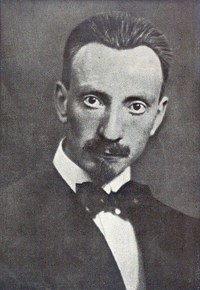
quotekg

React to this quote

More by Luigi Russolo

See all

“Each sound carries with it a nucleus of foreknown and foregone sensations predisposing the auditor to boredom, in spite of all the efforts of innovating composers. All of us have liked and enjoyed the harmonies of the great masters. For years, Beethoven and Wagner have deliciously shaken our hearts. Now we are fed up with them. This is why we get infinitely more pleasure imagining combinations of the sounds of trolleys, autos and other vehicles, and loud crowds, than listening once more, for instance, to the heroic or pastoral symphonies.”

“In antiquity, life was nothing but silence. Noise was really not born before the 19th century, with the advent of machinery. Today noise reigns supreme over human sensibility.”

“'Intonarumoris', Luigi Russolo 1913 - on Youtube”

“My dear Pratella, I submit to your futurist genius these new ideas, and I invite you to discuss them with me. I am not a musician, so that I have no acoustic preferences, nor works to defend. I am a futurist painter who projects on a profoundly loved art his will to renew everything. This is why, bolder than the bolder professional musician, totally unpreoccupied with my apparent incompetence, knowing that audacity gives all prerogatives and all possibilities, I have conceived the renovation of music through the Art of Noise.”

“Noise accompanies every manifestation of our life. Noise is familiar to us. Noise has the power to bring us back to life. On the other hand, sound, foreign to life, always a musical, outside thing, an occasional element, has come to strike our ears no more than an overly familiar face does our eye. Noise, gushing confusely and irregularly out of life, is never totally revealed to us and it keeps in store innumerable surprises for our benefit. We feel certain that in selecting and coordinating all noises we will enrich men with a voluptuousness they did not suspect.”

“Sound is defined as the result of a succession of regular and periodic vibrations. Noise is instead caused by motions that are irregular, as much in time as in intensity. 'A musical sensation,' says Helmholtz 'appears to the ear as a perfectly stable, uniform, and invariable sound.' But the quality of continuity that sound has with respect to noise, which seems instead fragmentary and irregular, is not an element sufficient to make a sharp distinction between sound and noise. We know that the production of sound requires not only that a body vibrate regularly but also that these vibrations persist in the auditory nerve until the following vibration has arrived, so that the periodic vibrations blend to form a continuous musical sound. At least sixteen vibrations per second are needed for this. Now, if I succeed in producing a noise with this speed. I will get a sound made up of the totality of so many noises--or better, noise whose successive repetitions will be sufficiently rapid to give a sensation of continuity like that of sound.”