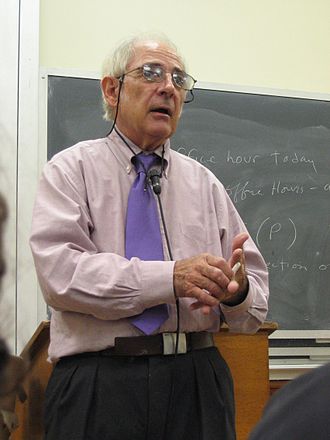
"The student should have enough knowledge of his or her cultural tradition to know how it got to be the way it is. This involves both political and social history, on the one hand, as well as the mastery of some of the great philosophical and literary texts of the culture on the other. It involves reading not only texts that are of great value, like those of Plato, but many less valuable that have been influential, such as the works of Marx. For the United States, the dominant tradition is, and for the foreseeable future, will remain the European tradition. The United States is, after all, a product of the European Enlightenment. However, you do not understand your own tradition if you do not see it in relation to others. Works from other cultural traditions need to be studied as well."
React to this quote
More by John Searle
See allResonant Thoughts
"The question of Spinozism is indeed central and indispensable to any proper understanding of Early Enlightenment European thought. Its prominence in European intellectual debates of the late seventeen…"
"Following the enormous conjecture in the press over the last two weeks, I wish to confirm that I have been tested HIV positive and have AIDS. I felt it correct to keep this information private to date…"
Explore Further
Related Quotes
"Cheer up. You never know — maybe something awful will happen tomorrow."
— John Waters"Buddhists speak of learning to see the world with “beginner’s mind,” and that’s precisely what you have to …"
— Michael Bérubé"Press on, therefore, as you have begun; perhaps you will be led to perfection, or to a point which you alon…"
— Seneca the Younger"I went to a denominational college and learned that since dictating the Bible, and hiring a perfect race of…"
— Sinclair Lewis"Do you know like, when you're a bloke nudist, Do you ever get any who just have like a small knob?"
— Karl Pilkington"The Founding Fathers, those who wrote the Constitution and founded the American Republic, they understood t…"
— Peter Schiff
Related Thinkers




Related Topics
Deep Dives
- Friedrich Nietzsche on knowledge
- Baruch Spinoza on knowledge
- Thomas Carlyle on knowledge
- Aristotle on knowledge
- Immanuel Kant on knowledge
- Ludwig Wittgenstein on knowledge
- Michel de Montaigne on knowledge
- Epictetus on knowledge
- Friedrich Nietzsche on life
- Friedrich Nietzsche on truth
- justice & Beauty
- justice & Change