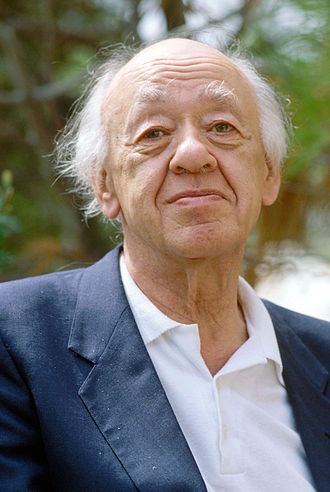
"I found ancestors, like Shakespeare, who said, in Macbeth, that the world is full of sound and fury, a tale told by an idiot, signifying nothing. Macbeth is a victim of fate. So is Oedipus. But what happens to them is not absurd in the eyes of destiny, because destiny, or fate, has its own norms, its own morality, its own laws, which cannot be flouted with impunity. Oedipus sleeps with his Mummy, kills his Daddy, and breaks the laws of fate. He must pay for it by suffering. It is tragic and absurd, but at the same time it’s reassuring and comforting, since the idea is that if we don’t break destiny’s laws, we should be all right. Not so with our characters. They have no metaphysics, no order, no law. They are miserable and they don’t know why. They are puppets, undone. In short, they represent modern man. Their situation is not tragic, since it has no relation to a higher order. Instead, it’s ridiculous, laughable, and derisory."
React to this quote
More by Eugène Ionesco
See allResonant Thoughts
"In a conflict which engaged all the major nations of the earth and lasted for a period exceeding four years, there could be no expectation of material gains. War in its very essence means destruction.…"
Explore Further
Related Quotes
"The plan of the present paper is to discuss properties of systems more or less abstractly; that is to defin…"
— Arthur D. Hall"It appears to be a quite general principle that, whenever there is a randomized way of doing something, the…"
— Edwin Thompson Jaynes"I am for no master nor moral persuasion. I am for myself. What your yearning soul, madam, might mistake for…"
— Michael Moorcock"Those who are susceptible to depravity do not need cinema or theatre to mislead them. There are numerous ot…"
— Dadasaheb Phalke"Yahya related to me from Malik that he had heard that the Messenger of Allah, may Allah bless him and grant…"
— Prophet Muhammad ﷺ"Whitehead's Principle of Relativity" by John Lighton Synge"
— Alfred North Whitehead