"When the business man rebukes the idealism of his office-boy, it is commonly in some such speech as this: “Ah, yes, when one is young, one has these ideals in the abstract and these castles in the air; but in middle age they all break up like clouds, and one comes down to a belief in practical politics, to using the machinery one has and getting on with the world as it is.” Thus, at least, venerable and philanthropic old men now in their honoured graves used to talk to me when I was a boy. But since then I have grown up and have discovered that these philanthropic old men were telling lies. What has really happened is exactly the opposite of what they said would happen. They said that I should lose my ideals and begin to believe in the methods of practical politicians. Now, I have not lost my ideals in the least; my faith in fundamentals is exactly what it always was. What I have lost is my old childlike faith in practical politics."
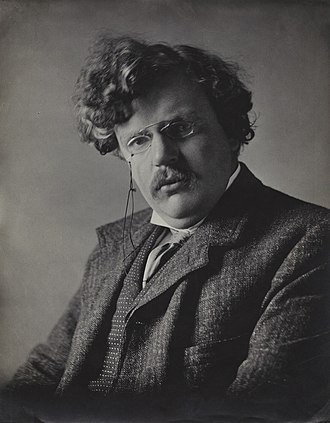
React to this quote
More by G. K. Chesterton
See allResonant Thoughts
"I don't understand how many painters can be so short-sighted to value art from earlier periods as completely worthless. Every art is an expression of an era and only for that reason already it is inte…"
Explore Further
Related Quotes
"As a rule we disbelieve all the facts and theories for which we have no use."
— William James"I believe that the root of almost every schism and heresy from which the Christian church has ever suffered…"
— John Ruskin"It is not necessary to believe that a political consensus to focus on the lives of the most disadvantaged w…"
— Kimberlé Williams Crenshaw"It was dangerous to have a sadist in the barracks, especially one who justified his excesses by religiously…"
— Pat Conroy"We're not doing what we do because of sanctions. We're doing what we do because we believe it is right."
— F. W. de Klerk"The American credo is one of faith in institutional pluralism and of mistrust of large size and concentrate…"
— Neil H. Jacoby





