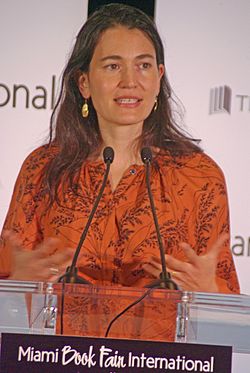
Nicole Krauss
Nicole Krauss is an American author best known for her four novels Man Walks into a Room (2002), The History of Love (2005), Great House (2010) and Forest Dark (2017), which have been translated into 35 languages. Her fiction has been published in The New Yorker, Harper's, Esquire, and Granta's Best American Novelists Under 40, and has been collected in The Best American Short Stories 2003, The Best American Short Stories 2008 and The Best American Short Stories 2019. In 2011, Nicole Krauss won an Anisfield-Wolf Book Award for Great House.
Background
- Born in
- Manhattan
- Educated at
- Stanford UniversityCourtauld Institute of ArtSomerville CollegeGoodenough CollegeThe Wheatley School
- Awards
- 🏆 Guggenheim Fellowship🏆 Marshall Scholarship🏆 Anisfield-Wolf Book Awards🏆 Berlin Prize🏆 Edward Lewis Wallant Award
Trending & Selected Quotes
Trending topics shown firstWorks & Publications
No works or publications documented yet.
Timeline
1974
Born
Birth
Influenced By
Thinkers whose ideas shaped Nicole's philosophy


Influenced
Thinkers whose work was shaped by Nicole's ideas
No influenced thinkers documented yet.
Source Attribution
Information about Nicole Krauss is sourced from curated knowledge bases and cross-referenced for accuracy. Influence relationships are scored by thematic overlap and historical plausibility.
Related Thinkers
See all →


Explore Further
Related Quotes
"It was England in the autumn; the sun was, by definition, something that only happened when it wasn't cloud…"
— Neil Gaiman"You should leave that place, my girl” “you know me better than that.” “yes, I do. Too brave for your own go…"
— Alice Borchardt"When I hate so much / that my eyes no longer close, / when I love so much / that I move, eyes open / close,…"
— Mirkka Rekola"The great mistake of the reformers is to believe that life begins and ends with health, and that happiness …"
— Katharine Fullerton Gerould"The truth is that it is our attitude towards children that is right, and our attitude towards grown-up peop…"
— G. K. Chesterton"You know how a play in dialect is. At the first act, you think, “How quaint!”; at the second act, you wish …"
— Dorothy Parker





