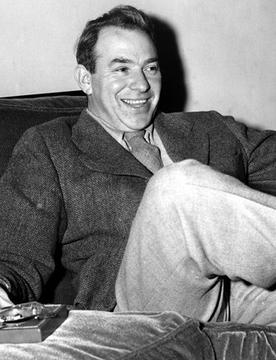
Yip Harburg
Edgar Yipsel "Yip" Harburg was an American popular song lyricist and librettist who worked with many well-known composers. He wrote the lyrics to the standards "Brother, Can You Spare a Dime?", "April in Paris", and "It's Only a Paper Moon", as well as all of the songs for the film The Wizard of Oz, including "Over the Rainbow". Harburg was known for the social commentary of his lyrics, as well as his left-wing political leanings.
Career Journey
Background
- Born in
- Lower East Side
- Educated at
- City College of New YorkTownsend Harris High School
- Awards
- 🏆 Academy Award for Best Original Song🏆 Johnny Mercer Award
Trending & Selected Quotes
Trending topics shown first"As the writer of the lyric of the song ‘God’s Country’, I am outraged by the suggestion that somehow I am connected with, believe in, or am sympathetic with Communist or totalitarian philosophy."
"E. Y. Harburg papers and E. Y. Harburg papers in the Billy Rose Theatre Collection of The New York Public Library for the Peforming Arts."
"The Atheist Lyricist Who Put the Rainbow in the Wizard of Oz" at Freedom From Religion Foundation"
"Yip Harburg: Secular Songwriter" by Dan Barker in Freethought Today Vol. 22, No. 3"
"A Tribute to Yip Harburg: The Man Who Put the Rainbow in the Wizard of Oz" at Democracy Now"
"Extended audio/print interview with Ernie Harburg, Yip's son and biographer"
Works & Publications
No works or publications documented yet.
Timeline
1896
Born
Birth1981
Died
Death
Influenced By
Thinkers whose ideas shaped Yip's philosophy
No known influences documented.
Influenced
Thinkers whose work was shaped by Yip's ideas
No influenced thinkers documented yet.
Source Attribution
Information about Yip Harburg is sourced from curated knowledge bases and cross-referenced for accuracy. Influence relationships are scored by thematic overlap and historical plausibility.
Related Thinkers
See all →


Explore Further
Related Quotes
"He was, this smoldering, passionate young pianist, generous, lovable, deeply gentle of heart."
— William Kapell"The average English critic is a don manqué, hopelessly parochial when not exaggeratedly teutonophile, over …"
— Constant Lambert"f all the arts, music makes the most direct appeal to the emotions and to those shadowy, but real portions …"
— Walter Raymond Spalding"brilliance in music will live in our hearts forever. His spirit as a humanitarian surpasses even that. It i…"
— Gloria Estefan"I didn't go to school until I was 11. On your own you develop imagination."
— Joanna MacGregor"I only fear God, know the weapons of the weak, the weakness of the heart, and never fall asleep..."
— Lupe Fiasco


