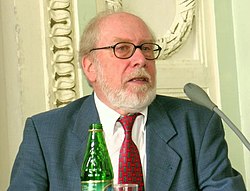
Niklaus Wirth
Niklaus Emil Wirth was a Swiss computer scientist. He designed several programming languages, including Pascal, and pioneered several classic topics in software engineering. In 1984, he won the Turing Award, generally recognized as the highest distinction in computer science, "for developing a sequence of innovative computer languages".
Career Journey
Background
- Born in
- Winterthur
- Educated at
- ETH ZurichUniversity of California, BerkeleyLaval University
- Awards
- 🏆 Turing Award🏆 Marcel Benoist Prize🏆 Computer Pioneer Award
- Doctoral Advisors
- 🎓 Edward Feigenbaum🎓 Harry Huskey
- Doctoral Students
- 📖 Martin Odersky
Trending & Selected Quotes
Trending topics shown first"... we do not consider it as good engineering practice to consume a resource lavishly just because it happens to be cheap."
"During the process of stepwise refinement, a notation which is natural to the problem in hand should be used as long as possible."
"Reliable and transparent programs are usually not in the interest of the designer."
Works & Publications
No works or publications documented yet.
Timeline
1934
Born
Birth2024
Died
Death
Influenced By
Thinkers whose ideas shaped Niklaus's philosophy
No known influences documented.
Influenced
Thinkers whose work was shaped by Niklaus's ideas
No influenced thinkers documented yet.
Source Attribution
Information about Niklaus Wirth is sourced from curated knowledge bases and cross-referenced for accuracy. Influence relationships are scored by thematic overlap and historical plausibility.
Related Thinkers
See all →


Explore Further
Related Quotes
"An object which is used to create instances, i.e., a template, description, pattern, or "blueprint" of a ca…"
— Edward V. Berard"Hunts differ in flavor, but the reasons are subtle. The sweetest hunts are stolen. To steal a hunt, either …"
— Aldo Leopold"Dirac's argument for electric charge quantization is not to be taken lightly because it is the first "topol…"
— Robert Marshak"I fear my ignorance."
— Isaac Asimov"Receive an injury rather than do one."
— Publilius Syrus"Theologically, man is to be understood as the final purpose of the creation; placed on the globe as the mas…"
— Carl Linnaeus


