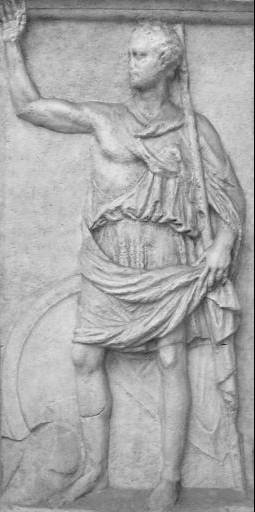
Polybius
Polybius was an ancient Greek historian of the middle Hellenistic period. He is noted for his Histories, a universal history documenting the rise of Rome in the Mediterranean in the third and second centuries BC. It covers the period 264–146, recording in detail events in Italy, Iberia, Greece, Macedonia, Syria, Egypt and Africa, and documents the Punic Wars and Macedonian Wars among many others.
Trending & Selected Quotes
Trending topics shown first"I observe that while several modern writers deal with particular wars and certain matters connected with them, no one, as far as I am aware, has even attempted to inquire critically when and whence th…"
"How striking and grand is the spectacle presented by the period with which I purpose to deal, will be most clearly apparent if we set beside and compare with the Roman dominion the most famous empires…"
"We can get some idea of a whole from a part, but never knowledge or exact opinion. Special histories therefore contribute very little to the knowledge of the whole and conviction of its truth. It is o…"
"The only method of learning to bear with dignity the vicissitudes of fortune is to recall the catastrophes of others."
"In all human affairs, and especially in those that relate to war, ...leave always some room to fortune, and to accidents which cannot be foreseen."
Works & Publications
No works or publications documented yet.
Timeline
-200
Born
Birth-120
Died
Death
Influenced By
Thinkers whose ideas shaped Polybius's philosophy
No known influences documented.
Influenced
Thinkers whose work was shaped by Polybius's ideas
No influenced thinkers documented yet.
Source Attribution
Information about Polybius is sourced from curated knowledge bases and cross-referenced for accuracy. Influence relationships are scored by thematic overlap and historical plausibility.
Related Thinkers
See all →

Explore Further
Related Quotes
"Hindus and Muslims can both be fanatics, but it is only Muslims who can be fundamentalists."
— K. S. Lal"Some have considered such photographs as evidence that Eakins, if not homosexual or bisexual, was at least …"
— Gordon Hendricks"It was a kind of Cadmean victory."
— Herodotus"But Alexander , proving himself to be an Argive, was judged to be a Greek; so he contended in the furlong r…"
— Herodotus"The enthusiasm for Indian culture was widespread. Amaury de Riencourt in his The Soul of India tells us tha…"
— Amaury de Riencourt"It was a court of politicians enforcing a policy, not a court of judges administering the law."
— Frederic William Maitland
