#philosophy
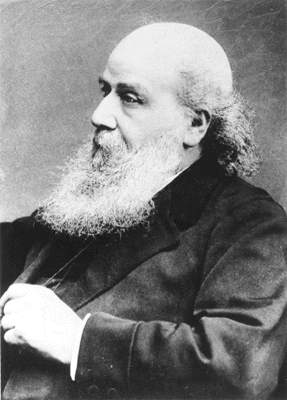
"Most, if not all, of the great ideas of modern mathematics have had their origin in observation. Take, for instance, the arithmetical theory of forms, of which the foundation was laid in the diophantine theorems of Fermat, left without proof by their author, which resisted all efforts of the myriad-minded Euler to reduce to demonstration, and only yielded up their cause of being when turned over in the blow-pipe flame of Gauss’s transcendent genius; or the doctrine of double periodicity, which resulted from the observation of Jacobi of a purely analytical fact of transformation; or Legendre’s law of reciprocity; or Sturm’s theorem about the roots of equations, which, as he informed me with his own lips, stared him in the face in the midst of some mechanical investigations connected with the motion of compound pendulums; or Huyghen’s method of continued fractions, characterized by Lagrange as one of the principal discoveries of that great mathematician, and to which he appears to have been led by the construction of his Planetary Automaton; or the new algebra, speaking of which one of my predecessors has said, not without just reason and authority, from this chair, “that it reaches out and indissolubly connects itself each year with fresh branches of mathematics, that the theory of equations has become almost new through it, algebraic 31 geometry transfigured in its light, that the calculus of variations, molecular physics, and mechanics” “have all felt its influence."
React to this quote
More by James Joseph Sylvester
See allResonant Thoughts
Explore Further
Related Quotes
"Maybe altruism is our most primitive attribute out of reach, beyond our control. Or perhaps it is immediate…"
— Lewis Thomas"On my return to Australia in 1985, a 12-year period of teaching in two institutions commenced—Mercy Teacher…"
— Deidre Brown"the social structure of cities will revert to the ecological pattern of 1880."
— Kenneth Boulding"Sagacity and eloquence are linked together to such an extent that they cannot be torn asunder for any reason."
— Philip Melanchthon"Erasmus dramatizes a well-established political position: that of the fool who claims license to criticize …"
— J. M. Coetzee"I just feel that there's a little bit of lack of respect and class just to kind of leave a tournament like …"
— Annika Sörenstam
Related Thinkers


Related Topics
Deep Dives
- Leonardo da Vinci on philosophy
- Blaise Pascal on philosophy
- Nicholas of Cusa on philosophy
- Kenneth Arrow on philosophy
- Charles Babbage on philosophy
- John Wallis on philosophy
- William A. Dembski on philosophy
- Leonardo da Vinci on life
- Leonardo da Vinci on nature
- Leonardo da Vinci on art
- knowledge & Beauty
- knowledge & Change