"Nor do such theories provide a ready account for the equivalence of the slopes of the reaction-time functions for the picture-plane and depth pairs. For, in order to explain the dependence of reaction time on angular difference, we must suppose that the features that are being compared are the features of the two-dimensional drawings, which differ more and more with angular departure, and not the features of the three-dimensional objects, which are the same regardless of orientation."
React to this quote
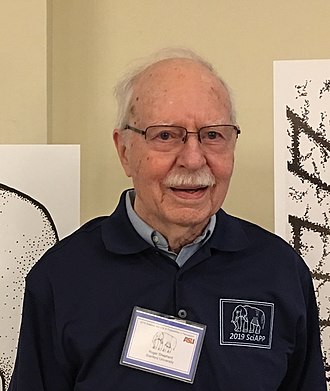
More by Roger Shepard
See allResonant Thoughts
"I quit smoking. It's very hard, but I'm glad I did. I'll tell you, this war against drugs in the US is the reason I quit because I got too fuckin' sick of being on the wrong side. The war against drug…"
Explore Further
Related Quotes
"Human beings, who are almost unique in having the ability to learn from the experience of others, are also …"
— Douglas Adams"I believe there is no philosophical high-road in science, with epistemological signposts. No, we are in a j…"
— Max Born"It is more shameful to distrust our friends than to be deceived by them."
— Confucius"The inanimate universe is related to the animate as means to end. We conscious individuals manipulate it in…"
— J. Howard Moore"When you take up lab-to-land transfer, you should know the socio-economic circumstances of the farmer. You …"
— M. S. Swaminathan"We build models to increase productivity, under the justified assumption that it's cheaper to manipulate th…"
— Stephen J. Mellor
Related Thinkers




Related Topics
Deep Dives
- Albert Einstein on philosophy
- Stephen Jay Gould on philosophy
- Carl Sagan on philosophy
- Charles Darwin on philosophy
- Michael Parenti on philosophy
- Galileo Galilei on philosophy
- Giordano Bruno on philosophy
- J. R. Partington on philosophy
- Albert Einstein on life
- Albert Einstein on science
- knowledge & Beauty
- knowledge & Change