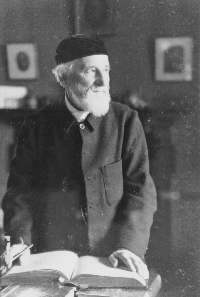
"Who are the greedy? Those who are not satisfied with what suffices for their own needs. Who are the robbers? Those who take for themselves what rightfully belongs to everyone. And you, are you not greedy? Are you not a robber? The things you received in trust as a stewardship, have you not appropriated them for yourself? Is not the person who strips another of clothing called a thief? And those who do not clothe the naked when they have the power to do so, should they not be called the same? The bread you are holding back is for the hungry, the clothes you keep put away are for the naked, the shoes that are rotting away with disuse are for those who have none, the silver you keep buried in the earth is for the needy. You are thus guilty of injustice toward as many as you might have aided, and did not."

React to this quote
More by Basil of Caesarea
See allResonant Thoughts
"Now, to balance the scale, I'd like to talk about some things that bring us together, things that point out our similarities instead of our differences. 'Cause that's all you ever hear about in this c…"
"AT ABOUT THIS POINT the weak-hearted reader usually sits down in the road, removes his shoes and weeps that he 'is a bad linguist' or that he or she can't possibly learn all those languages. One has t…"
Explore Further
Related Quotes
"President Obama keeps insisting that ISIS is not Islamic. Well, maybe they don't practice the Muslim faith …"
— Bill Maher"It's all been a bad joke that just ran out of control. I got into food for fun but the business got a mind …"
— Paul Newman"When one merely states that one has many subscribers and keeps on saying it, then one gets many; just as wh…"
— Søren Kierkegaard"Most accursed, wicked, barbarous, cruel, unnatural, unjust and diabolical."
— William Pitt the Younger"If anyone who wants to complain about human rights violations in Sri Lanka, whether it's torture, whether i…"
— Mahinda Rajapaksa"If you spend your time hoping someone will suffer the consequences for what they did to your heart, then yo…"
— Shannon L. Alder