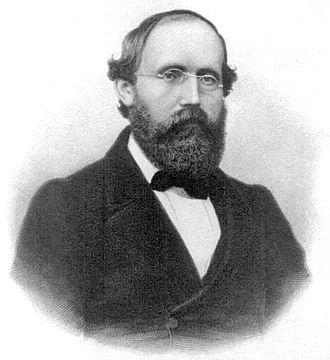
"Definite portions of a manifoldness, distinguished by a mark or by a boundary, are called Quanta. Their comparison with regard to quantity is accomplished in the case of discrete magnitudes by counting, in the case of continuous magnitudes by measuring. Measure consists in the superposition of the magnitudes to be compared; it therefore requires a means of using one magnitude as the standard for another. In the absence of this, two magnitudes can only be compared when one is a part of the other; in which case also we can only determine the more or less and not the how much. The researches which can in this case be instituted about them form a general division of the science of magnitude in which magnitudes are regarded not as existing independently of position and not as expressible in terms of a unit, but as regions in a manifoldness."
React to this quote
More by Bernhard Riemann
See allResonant Thoughts
"The word CHURCH had never any charm for me, in the mouths of those who made the most noise about it; for I could not perceive that they gave any other distinguishing proof of their regard for the thin…"
Explore Further
Related Quotes
"O light! This is the cry of all the characters of ancient drama brought face to face with their fate. This …"
— Albert Camus"Is marketing management an art or a science? Some marketing observers maintain that good marketing is more …"
— Philip Kotler"There is more to a science fiction story than the science it contains. There is also the story."
— Isaac Asimov"“Blasphemy” and “heresy” are terms of religion, not science."
— Jerry Coyne"Europe owes its greatness to the fact that the primary loyalties of the European people have been detached …"
— Roger Scruton"Poetry is a sort of inspired mathematics, which gives us equations, not for abstract figures, triangles, sp…"
— Ezra Pound
Related Thinkers


Related Topics
Deep Dives
- Leonardo da Vinci on Science
- Kenneth Arrow on science
- Charles Babbage on science
- John Wallis on science
- William A. Dembski on science
- Leonardo da Vinci on life
- Leonardo da Vinci on nature
- Leonardo da Vinci on art
- Leonardo da Vinci on knowledge
- Leonardo da Vinci on philosophy
- knowledge & Beauty
- knowledge & Change