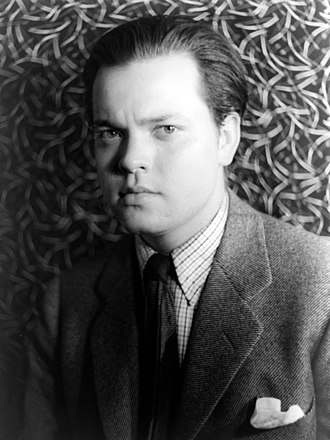
"Thank you, Donald, for that well-meant but rather pedestrian introduction. Regarding yourself, I quote from the third part of Shakespeare's Henry VI, Act Two, Scene One. Richard speaks, "Were thy heart as hard as steel/ As thou hast shown it flinty by thy deeds/ I come to pierce it, or to give thee mine." To translate into your own idiom, Donald; you're a yo-yo. Now I direct my remarks to Dean Martin, who is being honored here tonight...for reasons that completely elude me. No, I'm not being fair to Dean because - this is true - in his way Dean, and I know him very well, has the soul of a poet. I'm told that in his most famous song Dean authored a lyric which is so romantic, so touching that it will be enjoyed by generations of lovers until the end of time. Let's share it together. "When the moon hits your eye/ Like a big pizza-pie/ That's amore" Now, that's what I call 'touching', Dean. It has all the romanticism of a Ty-D-Bol commercial. "When the world seems to shine/ Like you've had too much wine/ That's amore" What a profound thought. It could be inscribed forever on a cocktail napkin. Hey, there's more. "Tippy-tippy-tay/ Like a gay tarantella" Like a gay tarantella? Apparently, Dean has a 'side Dean' we know nothing about. "When the stars make you drool/ Just like a pasta fazool .... Scuzza me, but you see/ Back in old Napoli/ That's amore" No, Dean; that's infermo, Italian for "sickened". Now, lyrics like that - lyrics like that ought to be issued with a warning: a song like that is hazardous to your health. Ladies and gentlemen... you are looking at the end result!"
React to this quote
More by Orson Welles
See allResonant Thoughts
"I had a friend, a companion of my own age, who, when he was twenty, had loved a young girl. He was poor, she was rich. Her family separated them. The girl married some one else and almost immediately …"
Explore Further
Related Quotes
"He submits to be seen through a microscope, who suffers himself to be caught in a fit of passion."
— Johann Kaspar Lavater"原文:"'There is no separation for us, my beloved child.' He touched my shoulder affectionately. 'Wherever you…"
— Mahavatar Babaji"Destiny is an absolutely definite and inexorable ruler. Physical ability and moral determination count for …"
— Aleister Crowley"In offering to you, my countrymen, these counsels of an old and affectionate friend, I dare not hope they w…"
— George Washington"I've been making a list of the things they don't teach you at school. They don't teach you how to love some…"
— Neil Gaiman"We must turn inwards to search deep within ourselves. “Is my heart still vibrant with life? Can I still exp…"
— Mata Amritanandamayi


